Showing posts with label Tire Kicking. Show all posts

Tuesday, August 16, 2016

Questions Answered About Chevy Cylinder Heads and Camshafts


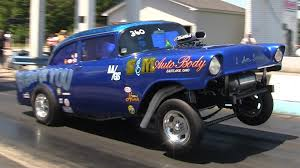
Big Block Chevy With Trick Heads Pulling a Hole Shot


Alan’s 1957 ChevyEngine Building Performance Questions Answered About Chevy Cylinder Heads and CamshaftsIn An One-On-One Bench Racing Session With My Old Friend, Bud Root


-Alan Arnell
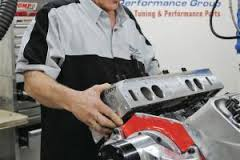

AFR Big Block Chevy 357cc Rectangle Port Magnum Aluminum Cylinder Heads


Alan;  What would be the deciding factor when deciding on the proper-sized intake runners or aftermarket cylinder heads?


BR;  Of course you must take in consideration the cubic-inch displacement of the engine.


Alan; Well then, besides an engine’s cubic inch displacement what other factors should be considered when choosing intake port sizes?


BR;  I got you thinking boy now don't I?  Let me make it hard for you which you know makes me feel superior?  Well then, how you plan to use the mill in your car of choice has to be though of by one and all.  Let’s say we want to put a 540-ci big block in your 1957 Chevy, that will be primarily driven on the street.  With your fat butt behind the wheel she would weigh close to 4,000 pound.  1955. 56 and 57 Chevy I would suggest buying the highest-flowing, largest ported head on the Market.  I built such a car back in 2006 and I choose a 357 Magnum Cylinder Head ‘cause of the engine’s huge displacement.  However, I found out that this set of heads would have run better with as 315cc set.  For that build, that  I did for an old buddy of mine, the idea was to make as much low-end torque as possible, ‘cause he wanted to run a 3.36:1 rear gears.  He is also a lead foot and drove routinely 45 miles to work one way in his hopped-up Triv-Five.  Lucky guy, right!  He wanted to drive his car on the street but still be a street/strip hot rod.  The 315cc head, like I said, in retrospect might have been the better choice.  But, you can’t know everything when you need too now can you, at least not me, but always evaluate what you do so the next time you will do it better.  Anyway, later the same guy wanted a newer setup after exploding his 12 bolt during a street race up by Fogg’s farm. We updated the drivetrain to a narrowed 9 inch Ford axle with at 4:56 gears as he decided to driving his Chrysler Crossfire to work and wanted the ‘55 for mostly Friday night drag racing.  We decided to put in a new set of heads with a 355cc.  


Alan’s Research Notes:  AFR - Airflow Research 3570 - AFR Big Block Chevy 357cc Rectangle Port Magnum Aluminum Cylinder Heads; Big Block Chevy 357cc Rectangle Port 24°
Manufacturer's Part Number:3570, sold as a pair at $3,081.69


Magnum Basic Package Components
100% CNC Ported Combustion Chambers
100% CNC Ported Exhaust Ports
100% CNC Ported Intake Ports
Competition 5-Angle Valve Job
Intake Valve Size - 2.300'' (Valve not included)
Exhaust Valve Size - 1.880'' (Valve not included)
Intake Valve Seats
Exhaust Valve Seats
Bronze Valve Guides


Big Block Chevy 357cc Rectangle Port 24° Magnum Head
Head Torque w/Moly Lube
75 Ft. Lbs.
Rocker Stud Torque
55 Ft. Lbs.
Intake Port Gasket, 1.775'' x 2.500'' with 1/2'' radius
Fel-Pro 375-1275 - DO NOT PORT MATCH Intake Manifold to Fel-Pro Gasket.
Exhaust Port Gasket
AFR 033-6858
Head Gasket Mark IV
4.540'' Bore, Fel Pro 375-1017
AFR 033-6850
Head Gasket Mark V - VI
Up to 4.500'' Bore, Fel Pro 375-1047
Head Gasket Mark V - VI
4.500'' to 4.600'' Bore, Fel Pro375-17049
Head Bolts & Studs
Standard ARP
Head Bolt Washers
Manley Standard
Stud Girdle
AFR 033-6210
Suggested Manifold
Edelbrock 350-2907 & 350-2927 or Brodix 158-HV2000 &158-HV2001
Spark Plug Starting Range
Champion C59C, Autolite 3932
Combustion Chambers
121cc Fully CNC'd
Intake Port Volume
357cc Fully Ported
Exhaust Port Volume
N/A
Spring Pocket can be cut to 1.750, no deeper.
Valve Spacing
Standard
Rocker Arms
Standard
Valve Angle
24° / 4° Intake ; 15° / 4° Exhaust
Angle Mill, 104cc Maximum
.009'' per cc
Flat Mill, As Cast 108cc, CNC 114cc Maximum
.006'' per cc
NOTE:
Flat and Angle mills might require a .120'' thick head gasket.


Alan;  How does compression and cam selection affect the best intake-runner size?


BR;  Well, camshafts and compressing ratios are so important, but camshaft choice plays a slightly larger part in a hot mill.  Let, me explain.  Let say, the ‘55s owner now wanted a strictly dragstrip door-slammer.  The guy wanted to keep running pump gas in a 11:1 somewhat street-friendly car.  He was running a .714-inch-lift solid mechanical roller which, you might know, is fairly aggressive. When push comes to shove, that cam will barely push the valve up to .700-inch lift after valve lash and deflection of valvetrain parts.  You gotta figure, .680 is more realistic.  So, in reality the flow data of the 335cc against the 357cc, you would clearly see that there ain’t much difference between the two until you start lifting the valves past .700. Now that’s not a problem even our race ‘55.  You see, all the larger head would have accomplished would have been a been a reduction in the overall airspeed ‘cause of the larger port and would have not made any additional volume of air.  You would find that, the valve lifted high enough to best use the benefits of the larger head.  I betcha, you would have a loss of low-end torque and have a wash, at best, when it comes to the actual peak power.  I have found that, such an engine would be lazier when driven at part-throttle.  You don’t want that!  No less, the fuel milage would go to shit, That rich bastard who owns the ‘55 would not care, but I would and I stand by my engines.  Maybe worse, the larger head would have wanted to run best at a higher rpm, which is no good for the camshaft we chose for the 11:1 street engine.  I say, take the exact same package and add two to three full points of compression, a cam with another 20 degrees of duration at .050 and a gross valve lift of .800 and that 540ci mill would be a G.. D..., F’en monster at 7,500 rpm’s with those 357 Magnum heads.  Anyway, that is what I think would be the best choice for this car.  
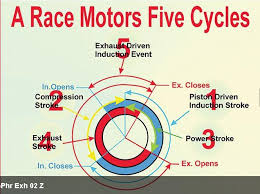


Alan;  When upgrading to aftermarket cylinder heads, how does overall flow affect camshaft selection?


BR;  That is a very important thing to consider, as the engine’s flow characteristic and valve timing are the two main things to get right for a fast car.  The two must be matched to make that power we all look for to have the fastest car.  Most people think that better-flowing head actually require less valve timing or shorter duration cams for a given rpm than a lower flow heads, but they’d be wrong.  That’s, ‘cause the better-flowing head can fill the cylinder faster, that is given the same signal from the piston than the less flowing heads.  I learned, that heads with high-flow ports are typically used only in high-rpm setups, they are typically used with relatively long duration cams.  Now, if you need to run the same rpm with a head that flows less, even more duration will be require.  So, on your street car with good heads, surprisingly little duration is needed to make the best horse power at say, 5,600 to 6,500-rpm.  A 350 mill with  250-plus-cfm head should make peak power in that range with a cam as small as 224- to 236-degrees at .050-inch to make great power that high.  One of the biggest myths about cam selection is that people think that big heads need a big cam.


Alan;  With high-flow aftermarket heads, how important is the intake versus exhaust flow ratio?


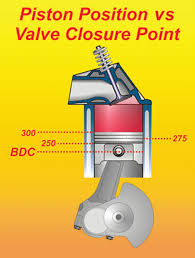
BR;  In the same way the exhaust-to-intake flow percentage does play a role in the camshaft choice.  To make this percentage right at a given lift, simply divide the exhaust flow by the intake flow and multiply by 100.  For example, a 250-cfm intake port and a 180-cfm exhaust port give a 72-percent flow number (180/250x100=.72)  As a engine builder, I shoot for about 72- to 75-percent flow for peak power.  A cylinder head in this range usually needs about six degrees more exhaust duration than intake duration to perform best between peak torque and peak power.  You see, the exhaust flow gets to 80 percent of the intake, the best cam selection should have about the same exhaust and intake duration  Likewise, heads that flowing the high 60s need more than 10 degrees extra exhaust-to-intake duration. As always, there is always an exception.  That’s when the combination needs to spend a substantial amount of time above peak power.  In that case the pumping losses happen while trying to push out the exhaust can hurt your horsepower output.  When that happens, as I have done for stock car racers’ engines,  I usually widen the separation and increase the exhaust duration that opens the exhaust valve earlier to allow more exhaust gas to escape near bottom dead center as the piston has to push it out.  This happens a lot in your larger-ci motors, due to high piston speeds and lower peak-power rpms.
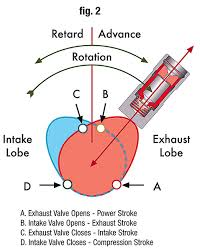


Alan;   Since most aftermarket heads can handle much more valve lift, how does that affect the choice of the net lobe lift?


BR;  Many of your trick heads don’t flow much more than the older heads I used back in the day. They range in the .100-inch to .300-inch valve-lift range.  Mostly, your trick heads more than likely take off above .300-inch valve lift, The older heads were made to around about .4-inch valve lift, so most of the work was done over time to improve low-lift flow.  Many new street valve-springs can handle lift above .600-inch, and some of the best endurance race springs will run over .800-inch valve lift for more than 500 miles of hard use.  Many a good drag racer engine builder is almost getting 1 ¼- lift, some even more!  With the additional lift available, two-valve cylinder heads can make great flow improvements at these higher lifts.  However, both the cam and the head must be made to work together in the higher range.  
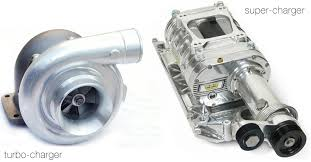


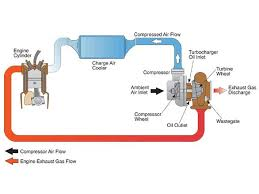
Alan;  How do you make a selection differ with forced-induction applications running high-flow heads?


BR;  Using a turbo or a blower, can change the cam choice ‘cause of the forced pressure differences across chamber.  With a blower I have to consider that too much overlap forcing the intake charge through the chamber and out the exhaust.  So, I typically widen the lobe separation.  You could also go with an earlier exhaust opening to run at a higher rpm.  On turbos you must pay close attention to the boost versus the backpressure to figger’ out overlap.  On older systems, the backpressure was very high and overlap would result in a bad reversion problems.  In later systems, pressures are much more constant across the chamber and cams are closer to those run in non aspirated setups, except, and there is always an exception.  Heads act much better with the dense charge, so duration can be much smaller for the same rpm.  The ricer’ guys with the four-valve motors typically need less overall lift due to the simaller valve diameters, greater curtain areas and increased lift-to-diameter ratios.
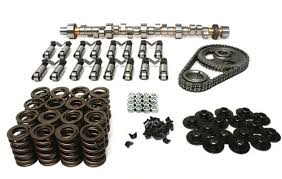


Alan;  There are so many variables to think of when picking out a cam.  Does it not make sense for the engine builder to just call COMP Cams for advice before buying a new cam?


BR;  Of course you could.  When you do, make sure you go over the details of the build before buying a cam.  Let me see,  I believe I have Comp Cams’ help line number here somewhere, here it is, 1-800-999-0853  I have found they are very good at helping you select a camshaft that best fits what you want the mill in you car to do for you.



BR;  Let me ask you this?  Are you following any of this at all?


Alan;  It’s a lot to think of, but if I ever get build my dream engine I will know more than I did yesterday.

A Great Tri5 Chat Board

~~~~


!!!Support Texas Classic Experience!!!
Did you like the blog?  If you did, the best way to support Texas Classic Experience is to share this post!  Please tell others that you liked this post by sharing it with your car friends by sending them a link to this page.  http://texasclassicchevyexperience.blogspot.com/


Don’t forget to visit and like Texas Classic Experience on FaceBook:  LINK to FaceBook
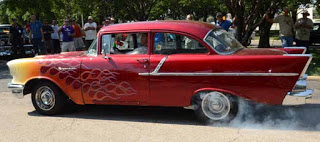
My winning Peel Out at the 2011 Lone Star Classic Convention in Dallas


Texas Classic Chevy Experience will post blogs about: Hot Rods, Chevy, Chevrolet, Drag Racing, Car Shows, Classic Cars, Custom Cars, Muscle Cars, How to Tech. posts, Dallas Area Classic Chevy Club, Texas Muscle Car Challenge, Tri-Five Nationals, Lone Star Chevy Convention, Classic Car lists, Classic car links, Spotters guides, Car Shows, Swap meets, Book reviews and More.


Tuesday, July 5, 2016

5.7 Vortec, 700-F and 3.73 gears in a 10 Bolt Differential


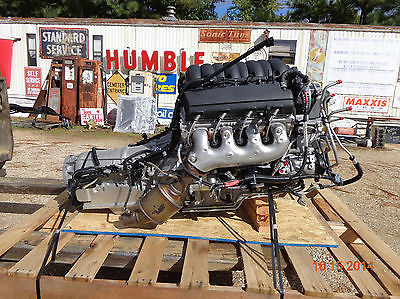
CHEVROLET 5.3 L83 ECOTEC 3 ENGINE AND TRANSMISSION


What I believe Would Be ThePerfect Powertrain Setup For A Modified Tri-Five Classic Chevy

-Alan Arnell

If I won the lottery, I would have many classic and sports cars in my garage for every want, wim and activity.  I would want a a modified Tri-Five to long trips, period correct Tri-Five, a Hot Rodded-1957 Chevy, a ground pounding-door slamming dragster, a couple of Corvettes (C-1, C-2, C-5 for starters), etc.  The lottery still being elusive, I have settled with my greatest heart's desire a 1957/150, 2-door 1957 hot rod, made to the style I would have made it if were it 1964.


~~~small Hell bitch.jpg
My 57/150, named the Hell Bitch!


For today’s topic: I wish to tire kick what I would like to have in a cruiser for the long distance haul to remote destinations.


I would start with a Chevy Vortec engine, most likely a 5.7 L with fuel injection.  However, a 4.8 L would be better for gas mileage and and may be purchased at a lower price, however to the detriment of less horse power.  Since, I’m dreaming, I will go with the 5.3 L engine.


The GM small-block engine family is an engine design intended as the primary V-8 engine used in General Motors' line of rear-wheel-drive cars and trucks. The GM small-block series was a "clean sheet" design with only the rod bearings and bore spacing in common in terms of shared parts and dimensions with the classic Chevrolet small block V8. The basic layout owes a good deal to the essential concept of Ed Cole's original small-block design of 1954-55, though the small-block engine also uses design cues from Buick, Oldsmobile, and Pontiac engines. Some small-block engines are all-aluminium, especially the performance oriented engines, while others use cast iron blocks.


The small-block engine has been the main power plant of the Chevrolet Corvette from 1956 to 2016, and has seen use in a wide variety of other General Motors vehicles, ranging from sport coupes to full size trucks. Due to the engine's relatively compact external dimensions compared to its displacement and power output, the engine family is also a popular choice for engine swaps, import cars, kit cars, hot rods, boats, buggies, and even light aircraft.


The Generation III V-8 engines replaced the Gen II-LT family in 1997 and Gen I completely by 2003. Like the previous two generations, the Buick and Oldsmobile small blocks, the gen III/IV can be found in many different brands. The engine blocks were cast in aluminium for car applications, and iron for most truck applications (notable exceptions include the Chevrolet TrailBlazer SS, Chevrolet SSR and a limited run of Chevrolet/GMC Extended Cab Standard Box Z71 Trucks). The architecture of the LS series makes for an extremely strong engine block with the aluminium engines being nearly as strong as the iron generation I and II engines and with the iron LS engines far exceeding the capabilities of the previous two generations.


The LS engine also used coil-near-plug style ignition to replace the distributor setup of all previous small-block based engines. The traditional five-bolt pentagonal cylinder head pattern was replaced with a square four-bolt design ( much like the 64-90 Oldsmobile V-8 ), and the pistons are of the flat-topped variety (in the LS1, LS2, LS3, LS6, LS7, LQ9 and L33), while all other variants, including the new LS9 and LQ4 truck engine received a dished version of the GM hypereutectic piston. The cylinder firing order was changed to 1-8-7-2-6-5-4-3, so that the LS series now corresponds to the firing pattern of other modern V8 engines (for example the Ford Modular V8).


The Vortec 4800 LR4 (VIN code "V") is a Generation III small block V8 truck engine. Displacement is 4.8 L (293 cu in) with a 96.01 mm (3.78 inch) bore and 83 mm (3.27 inch) stroke. It is the smallest of the Generation III Vortec truck engines and was the replacement for the 5.0 L 5000 L30. The LR4 engines in 1999 produced 255 hp (190 kW) while the 2000 and above models made 270–285 hp (201–213 kW) and all have a torque rating between 285–295 lb·ft (386–400 N·m), depending on the model year and application. The 2005-2006 models made 285 hp (213 kW) and 295 lb·ft (400 N·m), LR4s are manufactured at St. Catharines, Ontario and Romulus, Michigan. It uses flat top pistons.


LR4 applications:
2003–2006 Chevrolet Express/GMC Savana
1999–2006 Chevrolet Silverado/GMC Sierra 1500
2000–2006 Chevrolet Tahoe/GMC Yukon


5.3 L
The Vortec 5300, or LM7/L59/LM4, is a V8 truck engine. It is a longer-stroked (by 9 mm (0.35 in)) version of the Vortec 4800 and replaced the L31. L59 denoted a flexible fuel version of the standard fuel LM7 engine. Displacement is 5.3 L (5,328 cc (325.1 cu in)) from 3.78-inch (96 mm) bore and 3.622-inch (92.0 mm) stroke. Vortec 5300s are built in St. Catharines, Ontario and Romulus, Michigan. Another engine variant, the L33, shares the same displacement, but has an aluminum block with cast in cylinder liners, much like the LS1.


As for a transmission: I would go for a 700-R or the 4L60.  The 700-R automatic overdrive transmission combined with deeper gears from 3.42 to 3.7:1 would be just the ticket for cruising Route 66.


The 700-R features a low 3.06:1 First gear combined with a 070:1 Overdrive that offers a good combination for sporty performance, make  for a pleasant  long hauler, with much better gas mileage than a Turbo 350.  The overdrive lops off a  thousand or more revs when driving on the Interstate, meaning, less wear and tear on the motor and fuel economy improvement of 30%.


In the past the benefits of the 700-R were appealing, however early models were considered weaklings in stock condition.  The clutch packs were weak, the servo/piston was too small, the pump was short on pressure and volume and the small clutch disc in the lockup torque converter was inadequate.  But by 1987 Chevy upgraded the transmission and today aftermarket models are even better still.  No worries.


One item of note:  if you cruiser runs a tall gear set like a 2.41, installing an overdrive trans. throws off highway cruising rpm.  Sure, the lower first gear will help acceleration, but when the fourth-gear overdrive kicks in that 2.41 becomes a 1.68!  This means that the engine will be lagging well below its effective rpm range.  


Since, I may not want to run a computer for the lock up torque converter via the speed sensor.   I would most likely choose to modify the transmission so the converter will lock up without the use of a computer.  This could be done by installing a modified pressure switch that locks up the converter in Third and or Fourth gears and a rewired converter solenoid.  This solenoid is also wired through the brake switch for safety.  Some systems also incorporate an engine vacuum switch that unlocks the converter on hard acceleration.  


The deep gears and lower first-gear ratio should make for some personally to my Tri-Five cruiser.  I would like a car that is responsive and quick off the line, yet eerily quiet on the highway.  


Since the late 80s, nearly every modern car has been made with an overdrive trans.
And lock up torque converter.  It is easy to see why.
 They’re a no-compromise solution that offer the best of both worlds.  

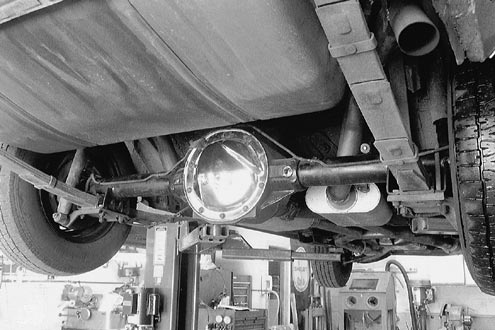
As for the rear end I would most likely go for a 7.5-inch GM 10-bolt,  While not as strong as the 8.5-inch 10-bolt or the 12-bolt, the 7.5 is adequate for modern street use-just not with 2.41 gears.  


Well for the want of money I am and most likely just be in the thinking and wanting stages for this Tri-Five powertrain setup.  But, you never know, I may swap out my carbureted 1977-stroked and bored 383 small block and 4-speed Borg/Warner to the cruiser setup I fancy.  


THM700R4 / 4L60 / 4L60E / 4L65E / 4L70E


The four-speed Turbo Hydra-Matic 700R4 was introduced for the 1982 model year for use in Chevrolet/GMC vehicles


In 1990, the Turbo Hydra-Matic 700R4 was renamed the 4L60, Under the new designation, the "4" stands for the number of forward gears, the "L" for longitudinal applications (rear-wheel-drive), and the "60" is the strength rating (less than the 4L80). "60" is the relative torque value. For example, 80 is stronger than 60, which is stronger than 40, etc.  A 4L80-E can handle more torque than a 4L60-E. The "E" denotes electronically controlled shifting. The 4L60 however is hydraulically shifted based on governor pressure and TV cable position.1992 was the last year of widespread usage of the 700R4 (4L60). 1993 Camaro, Corvette and Typhoon were equipped with the last production 700R4.The last design change of the 700R4 was an added checkball to the valve body.


In 1992 electronic controls were added, and it became the 4L60-E.  The 4L60E went into service in trucks, vans, and SUVs in 1993 and in all RWD passenger cars (Corvette, F and B/D bodies) in 1994.


In 2001, an updated version — the 4L65-E, was introduced Five-pinion planetaries, along with a strength-improved output shaft, were improved to withstand the 300+ lb·ft (400+ N·m) of torque of the 6.0 Vortec engine.The 4L70E transmission is the same as a 4L65E with a speed sensor located in the pump.700R4 / 4L60 / 4L60E / 4L65E / 4L70E / Technical Description.

The Turbo Hydra-Matic 700R4 can be identified by an oil pan number six shown at General Motors Transmission Pans.


The tailshaft housing is held onto the main case by four bolts (the bolt spacing is similar to the THM350) and uses a square-cut o-ring seal, and not a gasket. The typical width of this transmission where it bolts to the engine is 20 in (51 cm) overall. From the engine/trans mating surface to the cross member mount bolt is 22.5 in (57 cm),and engine/trans surface to output shaft housing mating surface is 23.375 in (59.37 cm) overall,with the tail shaft housing typically measuring 7.625 in (193.7 mm).


Transmission fluid cooler lines on the 700R4 the bottom fitting on the right side of the transmission is the "out" line to the cooler and the top fitting is for the return line from the cooler. These fittings are .25 in (6.4 mm) pipe thread, and can include an adapter from the factory for threaded steel lines in a SAE size 4L60Es manufactured after 1995 use snap-in connections instead of threaded.


In 1995, the 4L60E received a PWM-controlled lockup converter.  The early designs simple on or off lockup function while the later design can variably lock as to not feel the lock up occur.    GM added a 5th solenoid to the valve body, called the PWM solenoid


In 1996, GM introduced a redesigned 4L60E transmission case that incorporated a bolt-on bell (2 piece case, bell and case) housing and an 6 bolt tail housing.This 2 piece case style was first seen in 1996 and up model S-10 Blazer, S-10 Truck, GMC Jimmy, and GMC Sonoma with the 4.3L engine. In the large majority of 1998 & later applications of the 4L60E were 2 piece cases (i.e., a removable bellhousing).  Both transmissions are the same internally.   The non-PWM (1993-1994) style 4L60Es are not interchangeable with PWM-style (1995 and later) 4L60Es Also in 1996, GM changed the 3-2 solenoid to a different style which makes it not interchangeable with any previous models


For the model year 1996 GM trucks, there were 2 versions of the 4L60E transmissions One had a bolt on bell housing the other did not. The bolt on bellhousings used on the 4.3L and 1996-2002 GEN I+ versions of the Small Block Chevrolet used the same bellhousing while the LSx engines used a longer bellhousing to accommodate a redesigned torque converter with a longer pilot nose (GM sells an adapter assembly for using the LSx 4L60-ES when used with an early engine).


The gearing for the 700-R is:
First - 3.06:1
Second - 1.63:1
Third - 1.000:1
Fourth - 0.70:1
Reverse - 2.29:1


GG 16.JPG
With this car you could take a trip and never want to come home!


!!!Support Texas Classic Experience!!!
Did you like the blog?  If you did, the best way to support Texas Classic Experience is to share this post!  Please tell others that you liked this post by sharing it with your car friends by sending them a link to this page.  http://texasclassicchevyexperience.blogspot.com/


Don’t forget to visit and like Texas Classic Experience on FaceBook:  LINK to FaceBook
My winning Peal Out at the 2011 Lone Star Classic Convention in Dallas

Texas Classic Chevy Experience will post blogs about: Hot Rods, Chevy, Chevrolet, Drag Racing, Car Shows, Classic Cars, Custom Cars, Muscle Cars, How to Tech. posts, Dallas Area Classic Chevy Club, Texas Muscle Car Challenge, Tri-Five Nationals, Lone Star Chevy Convention, Classic Car lists, Classic car links, Spotters guides, Car Shows, Swap meets, Book reviews and More.

*********************
A Great Tri5 Chat Board
~~~~
*********************************************************************************************************