Showing posts with label A/C. Show all posts

Tuesday, December 15, 2015

Part 2 Understanding Manifold Gauges and the Information Given

Part 2


Understanding Manifold Gauges and the Information Given
Air Conditioner Testing and Your Classic Chevy Tri-Five Car  
Classic Air Perfect Fit Air Conditioner Install
Retrofit A/C "Hillbilly How To"
Reflections of My Experiences of Installing A/C in My Classic Tri-Five 1957 Chevy
  -Alan Arnell


While you are testing you’re A/C system for faults you should set the engines RPM's at 1200 to 1500 RPM, which is slightly above idle. If you have an electric cooling fan and even if you don't you should not rev the engine or hold a high RPM. Doing so could create high pressures, which will make for a dangerous situation. The high pressure will happen, because the electric condenser fans are fixed in speed and will not compensate for the higher RPM's. A bad clutch fan will cause the same problem.


To start testing you have to set your car up in the so called "MAX" position. MAX may not be a true standard Automotive term, but that is what my friend called it when he taught me how to test my A/C system. Which is, the A/C system on max, the blower on high, doors closed and windows open. Why you ask? Let me tell you.


If you car's A/C setting is on fresh air mode, the heat from the engine could be drawn into the fresh air cowl under the wiper blades. Heat from the underside of the car is the same reason the test is done with the door closed. The heat from those two sources may falsely effect the heat load on the evaporator. Yet we keep the windows open.


Having the windows open helps create a typical and stable heat load. And, my favorite reason is, because it is easier to reach in the car to adjust and test the coolness of the A/C air with you hand.  Why make things hard?


Testing should be done with the blower on high. Low blower speed will reduce the heat load on the evaporator. Doing so may cause compressor cycling. You may put the blower on low to force the low side pressure down for the adjustment of the compressor cut-out pressure.


Orifice Tube
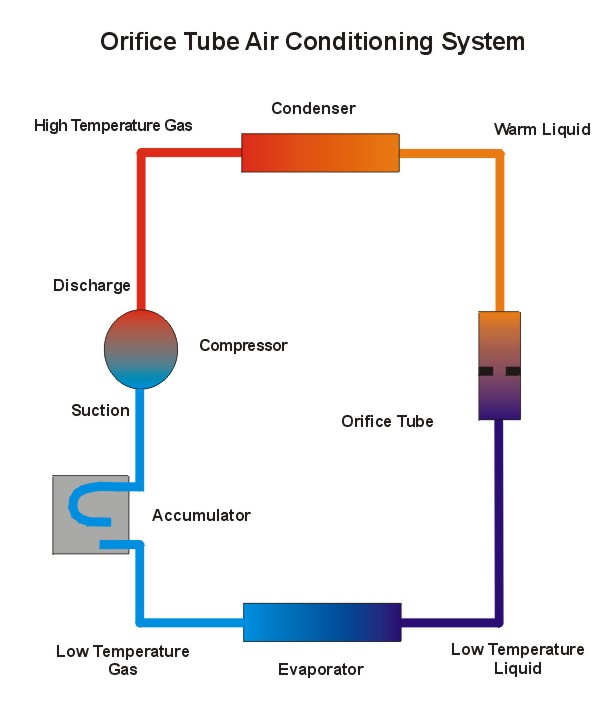
There is 30 psi on the low side and still hot air. Why? The most common reason is the orifice tube system. Even with the evaporator pressure at 30 PSI the refrigerant may still be low. Let us assume that only half the evaporator is full of boiling liquid refrigerant allowing only half the heat removing to occur. That means that only half of the air going through the cold is getting cooled.


Pressure readings will tell that the core temperature is near 30 degrees F, but only half the core is removing any heat. The system is close to being full, yet the discharged air is only slightly cool.


With a fixed orifice, when most folks charge with refrigerants, they will change until the inlet and the outlet of the evaporator is within a degree or two of one another. That is generally the test to see if the quantity of refrigerant is OK.


Nevertheless, at this point the boiling liquid may spill into the accumulator. The outlet will still be cold but a fault may still exist within the system.


The A/C System is still Working Under Hood but BLOWS Hot Air
You need to also be mindful that if the system is working, but for example, the cold air is not coming out of the vents. There may be a blockage or damper problem . If your car has sweat on the accumulator and the low pressure to the compressor it is a good bet that the problem may be in the passenger compartment.


Clogged Orifice Tube
Usually, a clogged or restricted orifice will usually show up as very low suction side pressure. The other side will also have lower than normal high side pressure. As the compressor turns on, the suction against the restricted orifice will cause the compressor to vary rapidly cycle out. When the compressor cuts out the rise in the suction side pressure will then be very slow. A quick compressor turn off and slow to start back up compressor may tell you that you have a clogged orifice. A clogged orifice tube is bad for more than not just allowing the A/C unit from cooling you off. The clog orifice may starve the compressor of oil and cause premature failure.


Bad Compressor
A non working compressor generally will not generate enough suction and pressure at idle at low speeds. If the engine RPM's need to be raised to bring up good pressures that is a sigh the compressor is going bad. Personal experience:  My daughter's PT Cruiser was fine on the highway, but when stopped at a red light the A/C air would go hot. I had her take the car in to have the compressor checked. It was ok. After much time and her complaining, I solved the riddle. The PT Cruiser has a two speed fan. The fan was only running at highway speed, which was a slower than needed fan speed for comfortable cooling at slow speeds. This is a prelude to my closing paragraph.


How was the compressor tested on my PT Cruiser and deemed OK? The tech. hooked up the gauges and the pressures were ok. When a compressor is running and the gauges are showing 80 on both side your compressor is broken. Those numbers show the compressor is not producing enough suction or making enough pressure. Adding or removing refrigerant will not make any difference to the low pressures indicated. A fully functional compressor must be able to pull a vacuum and create pressure.


Another way to tell if the compressor is bad was demonstrated by my 1978 Chevrolet black and silver Pace Car Corvette. The compressor froze up to smoke the fan belt and finally making it fall off completely. Of course the broken A/C belt wrapped around the remain belts having them all fall off. I saw white smoke pour out from under the hood. When I pulled over to the side of the road, I saw the power steering pump's power belt pass me rolling down the road like a wheel.


Compressors that use a variable stroke are often misdiagnosed as being defective, when only the internal pressure control device is a fault.


Bad Expansion Valve
Bad expansion valves are hard to diagnose. However, if the A/C is fine in the shop and goes bad on the road it may be the valve. The valves have also been know to stick open and closed or even stick somewhere in-between.


I have been told that the most commend valve failure is the valve being stuck closed . If the
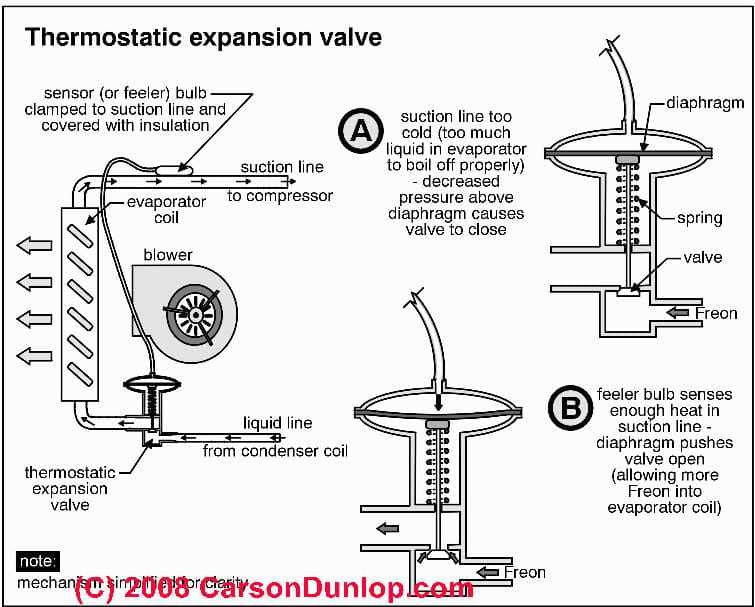
valve is stuck close the gauges will show very low suction side pressure and lower that normal high side pressure. The low side may even draw a vacuum. That the big clue. The stuck open valve shows higher than formal low side pressure and slightly higher that normal high side pressure. Don’t be fooled by the aforementioned readings and think that you have a weak compressor or slightly overcharged system.


There are so many more problems that can and will occur and ways to sniff them out. You must understand my blog today is very basic with its information. But, the blog's attended audience is the hobbyist and not the professional.


Please Help Grow The Texas Classic Chevy Experience by sharing the blog with your friends.  And, please check us out on FaceBook.


Monday, December 14, 2015

Fixing a Classic Chevy Auto Air Conditioner System with a Manifold Gauge Set-Part 1

Fixing a Classic Chevy Auto Air Conditioner System with a Manifold Gauge Set.
Diagnosing an  Auto Air Conditioner System on a Classic Car.  
Classic Air Perfect Fit A/C Install.
Retrofit A/C "Hillbilly How To".
Reflections of My Experiences of Installing A/C in My Classic Tri-Five 1957 Chevy.
  -Alan Arnell

So you did everything the directions told you and you have completed your retrofit A/C project for your BelAir.  Life is great, until you notice no cold air is blowing from the vents.  First be happy that nothing is on fire or being thrown from the engine bay.  Second, there is still hope, because you have a manifold gauge set.  There are many tools out there to fix A/C systems, but even for the most seasoned auto mechanic the manifold gauge set is the first, if not, the primary weapon in the arsenal for diagnosing a bad A/C system.

As a perquisite to this blog it helps if you understand how a refrigeration cycle works.  I discussed the cycle in the previous Blog section "How an A/C Works".  Understanding the role of pressure on the different A/C parts in your system is the only way to successfully fix the A/C' dysfunction.  The gauge set measures the pressure in the system to pinpoint problems.

If you are not familiar with a manifold gauge set you may read my blog section  "Manifold Hose/Line identification and Use"  for help.  In the earlier blog, I explained what the different gauges were and explained the color coding of the lines.


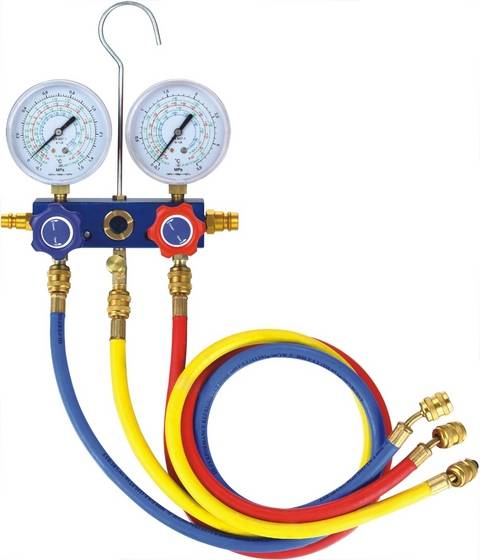
You now have the basics of the manifold gauges, but what are all those numbers on the two gauges? The blue gauge is the compound gauge.  We will refer to the compound gauge as the low side pressure gauge.  What all that means is the gauge is used to measure pressure or vacuum. The numbers around the outside of the gauge shows pressure in pounds per square inch (PSI).  The numbers near the bottom shows vacuum in inches of mercury.  The small scales in the middle of the gauge list the temperature relationship of different refrigerants.  The scale designated as PSI is the one you will use to read the system’s pressures when charging and diagnosing an A/C system  The gauge reads for 0 to 120 PSI.

The red gauge on the right is the high pressure gauge.  The high pressure gauge measures, you guessed it, the high pressure side of the A/C system.  This gauge only reads pressure.  As common  sense would dictate, this gauge measures the higher pressure side of the system.  The gauge therefore reads from 0 to 500 PSI.

Static Pressure
With the A/C system off and the temperature is stable that pressure reading is called static pressure.  If the manifold gauges are hooked up to measure static pressure the low and high side should be the same or very close. Both the high and low sides have equalized within the system.

Refrigerants  have different static pressure at different temperatures.  So, that static pressure of the system changes with the up and downs of the outside the A/C system temperature. The higher the  heat the greater the pressure.  There are charts out there to find static pressure related to different temperatures. Here is a link to a 134a System Pressure Chart chart of static refrigerant pressures

Static pressure can not be used to determine if a system is fully charge.  However, a good rule of
thumb is if the static pressure is 87 PSI at 79 degrees you can assume the system has some amount of liquid refrigerant.  The system may be or full not not full.

However, if at the same temperature of 79 degrees F the gauge shows 75 PSI then you would know the system is low.  This is because the static pressure on the gauge is lower than what is listed on the chart for your outside temperature.

So, if  you can't tell if you have one ounce or 20 pounds of refrigerant in the system with this test what is the point?  This test tell you there is enough pressure to satisfy the low pressure switch and let the compressor to do its job.

Static pressure may also be used to see if a can or more likely a jug of refrigerant has water in the jug.  Bad!

Your static pressure should not be lower than 50 PSI when leak testing.

Short Cycling
Have you ever witness an A/C system that the compressor clutch keep cycling on and off?  The rapid on and off of a compressor is referred to as short cycling?  That is because most systems have a pressure cutoff switch that turns the system off at around 20 PSI.  Even with low refrigerant after shutting down the pressure will build back up to 45 PSI allowing the switch to turn the compressor back on to just turn off again at 20 PSI.

With that knowledge most static pressures needs to be around 45 PSI for the system to work
properly.

Let's say you only have 45 PSI and warm air blowing out of the A/C vents.  You look at you gauge and the suction side draws pressure, the low side gauge will drop quickly and more than likely the compressor will shut on off.  The gauge will climb back to  45 PSI as the sides equalize.

Charging Pressures
I bet you would want to know what the pressure should be when testing.  But the experts can't say for sure.  Too many variables for them to say definitely.  It would be nice if they would just say 30 on the low and 200 on the high but, they won't.  Funny, and amazingly enough, when things are all said and done the gauges will be close to 30 and 200.

Here is why:  A reading of 30 on the low side is close, because that translates into an evaporator temperature close to the freezing point of water.  Remember that the left gauge has temperature scale.  The low side all-in-all is really measuring evaporator temperature.  We want to keep the evaporator temperature usually above 32 degrees F, because that part of the system is prone to  collecting water.  Frozen water is of course bad in your system. Generally, 134a's low side is slightly lower than freezing of water at around 27 PSI.

High Side
With the old R12 systems the high side pressure was usually 1.8 to 2.1 times the outside temperature.  Therefore, on an 80 degree day with average humidity the gauge would read 144 to 168.  On hot humid days like we have in Houston the old R12 pressures could go up 100 PSI.


With 134a it is common to see high side pressures at 2.2 to 2.5 times the outside temperature.  So that would be around 176 to 200 psi on the high side with 134a.

Due to the heat load on the evaporator, humidity in the outside air, airflow across the condenser  and engine speed makes the specific range to vary.

Meaning, that on you average 80 degree F day, the high side should be around 176 to 200 PSI.


Please check back for Part 2 of
Fixing a Classic Chevy Auto Air Conditioner System with a Manifold Gauge Set

Sunday, December 13, 2015

Part 4: How to charge your Classic Car's A/C

Part 4
How to charge your Classic Car's A/C System
Retrofit A/C "Hillbilly, How To"
Reflections of My Experiences of Installing A/C in My Classic Tri-Five 1957 Chevy
All put together ready for a charge of 134a
     -Alan Arnell


If  not done correctly, charging your A/C system, yourself, you run the risk of causing problems with the system. Thus it is the recommendation of:  If in in doubt hire a qualified and certified A/C Tech. Still, if you are careful and understand the procedures while completing required steps you may charge the system yourself.


The following Tech Steps are based on how to charge your Classic Auto. with 134a.


How an A/C Works


An A/C system has several parts to consider. Those parts are the condenser, compressor and the evaporator.


My unit is running a little hotter that I liked.
Later, I replace a hose.and recharged the system
The condenser and the evaporator are really two radiators hooked in a loop. All A/C systems are sealed from the outside. The inside of the A/C has a fluid refrigerant inside, that refrigerant I am using  in my CAA system is 134a. The compressor takes the 134a at low pressure and compresses it. This compression produces heat.  The compressor then sends the compressed 134a  to the condenser. The condenser dissipates the heat to the outside world. After passing through the condenser the refrigerant now a liquid travels to the evaporator in the passenger compartment.


While the refrigerant goes through the evaporator the liquid is allowed to expand removing the heat and cools the evaporator. A fan pushes air through or over the evaporator producing cool air for your driving pleasure. That is why the whipped cream can gets cold when you are making a Sunday.


It is important to know that this cycle of hot and cold when subjected to moisture, the moisture will damage parts of the system. If your A/C system ever springs a leak do not wait to get it repaired. If you wait, moisture will get into the system causing a more costly repair job.


Evacuate the System


To start the charging routine you must first draw a vacuum or so called, evacuate the A/C system. This vacuum is important to properly fill the system with refrigerant. Evacuating removes the moisture and other contaminants. The vacuum also aids in adding oil, if needed, and refrigerant.


In the Classic Air retrofit project, that I am writing about, the put together project needs refrigerant to work.   Before the refrigerant can be put in the system a vacuum pump must be used to evacuate the system.  If there was refrigerant in the system you should evacuate the system with a capture unit to keep refrigerant out of the atmosphere. Doing so keeps that nasty hole in the oxone smaller.


Note - Charging an A/C system involves toxic chemicals that are under high pressure: Know what you are doing before performing any A/C work. BE SAFE & KNOWLEDGEABLE!


Tools You Will Need
Manifold gauges
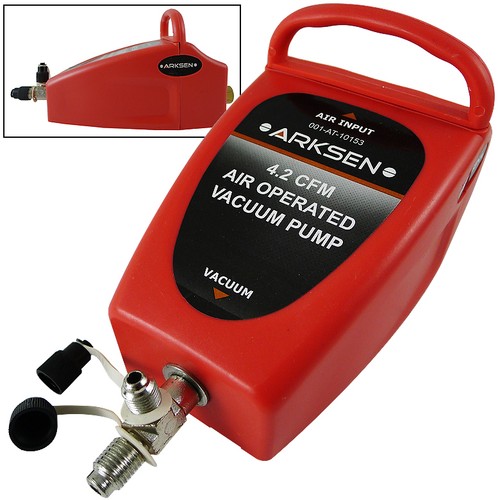
Vacuum pump
Small thermometer


How to Tech: Charging an A/C System
  1. Evacuate your A/C unit, but first check all the fittings for tightness again
  2. Connect the manifold gauges
  3. identify the high pressure side
  4. identify the low pressure side


Manifold Hose/Line identification and Use
  1. The high pressure side uses the blue hose
  2. The red hose is for the high pressure side
    Typical Manifold Gauge Set
  3. The yellow hose is the service line, the service line is use to pull out and put in what you want in the system
  4. At this point you could purge the system with compressed nitrogen. Most shade tree guys don't have this equipment and getting access to it is rare. However this process can be skipped. Deep vacuuming the system will get rid of the moisture and check for leaks.
  5. Attach the yellow service line to the vacuum pump with the high and low sides of the manifold closed.
  6. With the pump running open both the high and the low sides of the manifold gauges.
  7. Check for leaks by using the low side gauge indicator. That indicator shows both pressure (PSI) and NS vacuum (in/hg). If the needle does not go below zero, you have a leak in the system.
  8. If the needle is below zero let the pump run for five minutes. After five minutes close the high side valve and turn the pump off.
  9. Note the reading on the low side gauge
  10. After another five minutes of waiting if there is a decrease in the gauge you have a leak. Stop and fix your leak before proceeding
  11. With all leaks stopped, restart the pump
  12. Open the high side valve again
  13. Run the pump for thirty minutes or how long the pump's instructions tell you to evacuate.
  14. With the system evacuated close both the high and low valves.
  15. Turn off the pump
  16. If done correctly all air and moisture is now out of the A/C system


Adding Oil
  1. Remember if you are installing a new CAA unit the oil has already been put in the compressor for you
  2. However, if working on another system that needs oil here is a how to put oil in the system
    Tapping Valve
  3. Note:  If you are repairing an existing A/C system you will  need to drain all the old oil out of the compressor and replace the dryer, Measure the correct amount of oil your system requires.
  4. If you have the compressor off you can simply pour the oil into them.
  5. If the compressor and the dryer is in place you can use the evacuated system’s vacuum to draw the oil in the system  Now let us go back to the CAA steps
  6. With the engine off connect a can of oil to the manifold system by first attaching the tapping valve attachment to the service line.
  7. Open the valve on the oil can and crack open the service line at the manifold until oil leaks out to purge air out of the service line
  8. Holding the oil can and valve upside down, open the low side valve, the vacuum will draw oil into the system
  9. When the can is emptied, close the low side valve and the valve on the can, remove can


Charge the System with Refrigerant
  1. Start the engine
  2. Place the A/C controls on the dashboard to high and the fan to low
  3. Let the engine idle for five minutes to get the pressures and temperatures to their correct levels
  4. While waiting for the engine to warm up - connect a can of refrigerant to the tapping valve connected to the service line
  5. Turn the A/C fan on high
  6. Purge the service line by cracking open the service line nut at the manifold until all unwanted air leaks out the the service line
  7. Open the low side valve on the manifold
  8. Hold the can upside down, this will help put the refrigerant in as a liquid
  9. Note: Never open the high side valve at this point of charging
  10. When the can is empty, shut the low side valve, then shut the can valve, remove the spent can
  11. Depending on the size of the A/C unit you may have to use two or three cans.
  12. High and Low Manifold Gauges
    Check your gauges for a full charge
  13. Run the fan on high with all the windows open. The engine should be set to 1500 RPM
  14. To read the gauges a good rule of thumb with 134a is that the high pressure (PSI) should be about 2.2 to 2.5 the outside air temperature, for example say it is 90 degrees F in your work area. your gauges should not read higher than 225 (PSI)


Next time I will discuss how to “Troubleshoot an Auto Air Conditioner With Manifold Gauges.”


Please check back for the rest of the story.


Alan