Showing posts with label Trifive History. Show all posts

Monday, November 7, 2016

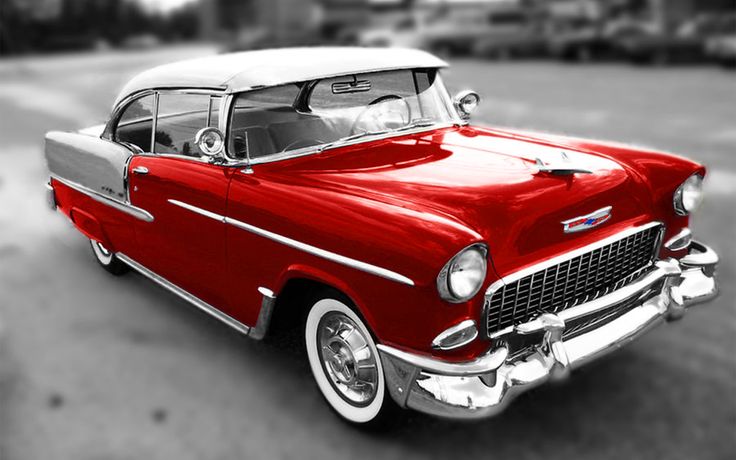
History and Options of 1955 Chevrolet Tri-Five Carburetors Part, 1 "1955"

History and Options of 1955 Chevrolet Tri-Five Carburetors Part 1 "1955"

23cb5d925242353d45a5f879539001d7.jpg

History of the Tri-Carburetor 1955

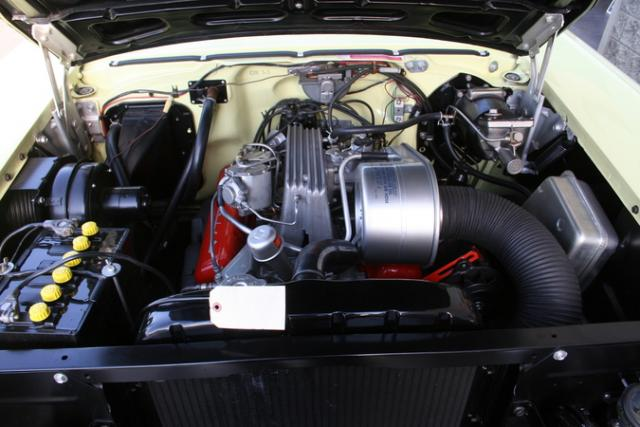
One of the most influential elements of the Tri-Five was the recent development of their newest 265 cid (4,340 cc) V8 engine, which was first offered in 1955. It was an overhead valve high compression, short stroke design that remained in production in various forms for decades. The base V8 had a two-barrel carburetor and was rated at 162 horsepower (121 kW), and the "Power Pack" option featured a four-barrel carburetor and other upgrades yielding 180 brake horsepower (130 kW). Later, a "Super Power Pack" option added high compression and a further 15 brake horsepower

In 1955 the 265 arrived on the scene with a 3.75-inch bore and 3.00-inch stroke (95.2 – 76.2 mm). It made 162 horsepower and 257 lb-ft in base form with a two-barrel carburetor. An optional Power Pack added a four-barrel carburetor (and other modifications) taking power up to 180 horsepower and an even 260 lb-ft of torque. When fitted to the Corvette, the 265 made 195 horsepower through a dual exhaust system. Later in the year Chevrolet added a Super Power Pack option to the Bel Air, taking it to Corvette power levels.

1955
Six Cylinder Carburetor
Rochester Model “BC”
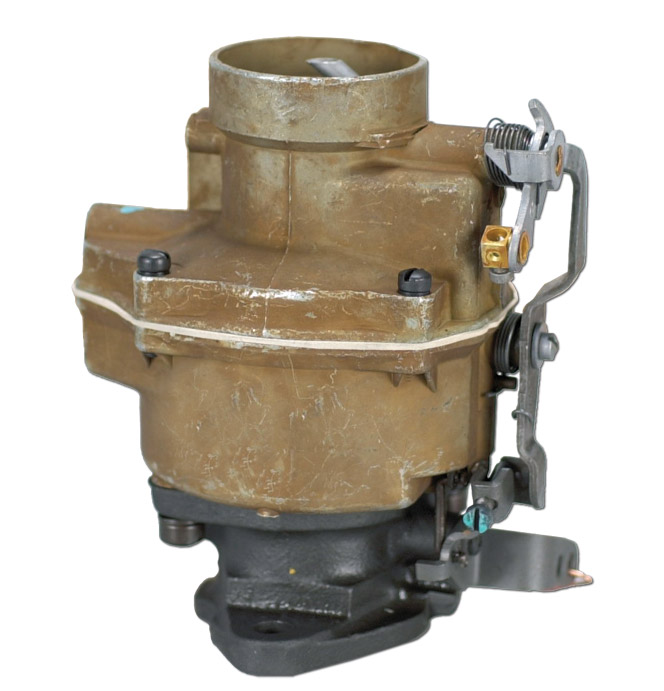
(1947-59) Rochester Model “BC” Carburetor, 6-Cylinder 235 CI Engine

The carburetor used on all six cylinder models is the Rochester Model “BC” down carburetor, equipped with an automatic choke.  This carburetor presented several distinct features of importance.

  1. Concentric fuel bowl-Regardless of any shift of fuel level in the bowl, the main metering jet is at all times immersed in fuel.
  2. Centrally located main discharge nozzle-a shift in fuel level has little or no effect on the rate of discharge from the nozzle.
  3. The main well and supported assembly, which contains the main metering jet and the power valve, is attached to the cover and suspended in the float bowl which provides ease in servicing.
  4. Automatic Choke-Insures proper starting and driving carburetion during cold weather operations.
  5. A fast idle mechanism, which is in linkage with the choke lever, is an aid to more efficient cold weather warm-up, insuring correct idle speeds during warm-up period.  

Rochester B BC BV Exploded View

Eight Cylinder Model Carburetor
Rochester 2GC
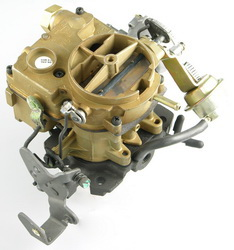

Rochester Model “2GC” Carburetor 8-Cylinder 265 CI Engine

The rochester Model 2GC two barrel carburetor was standard equipment on all 1955 Chevrolet's’ eight cylinder models.  While not interchangeable, the carburetors used on powerglide-equipped models and standard shift models are basically the same, and description and service operation are identical.  The carburetor incorporates the calibrated cluster design.

The cluster casting is the heart of the carburetor; it embodies the small or secondary venturi, the high speed passages, the main well tubes and nozzles, the idle tubes and the calibrated air bleeds for both the low and high speed metering systems, as well as the accelerating pump jets.

When the cluster is removed for service purposes, all of the vital parts can be readily seen, cleaned and examined; the main well tubes and idle tubes are permanently installed in the cluster body by means of precision pressed fit.

The cluster fit on a platform provided in the body casting of the carburetor so that the main well and idle tubes are suspended in the fuel.

A gasket is used between the cluster casting and the body platform.  This method of design and assembly serves to insulate the main well tubes and idle tubes from engine heat, thus reducing heat expansion and percolation spill-over during hot idle periods of operation and during the time the hot engine is not operating.

An external vent with a  protective cover to keep out dirt and other foreign matter is located in the center of the bowl cover to provide adequate venting  of the unit under all types of operating conditions.

The Model 2GC carburetor functions conventionally, using the standard six systems of carburetor: Float, Idle, Part Throttle, Poser, Pump and choke.  These systems are basically simple and easily be traced and understood.

The Model 2GC carburetor is of side bowl construction.  It is designed, however, with fuel supply jets and passages submerged enough below the liquid level to provide proper engine operation under all driving conditions.
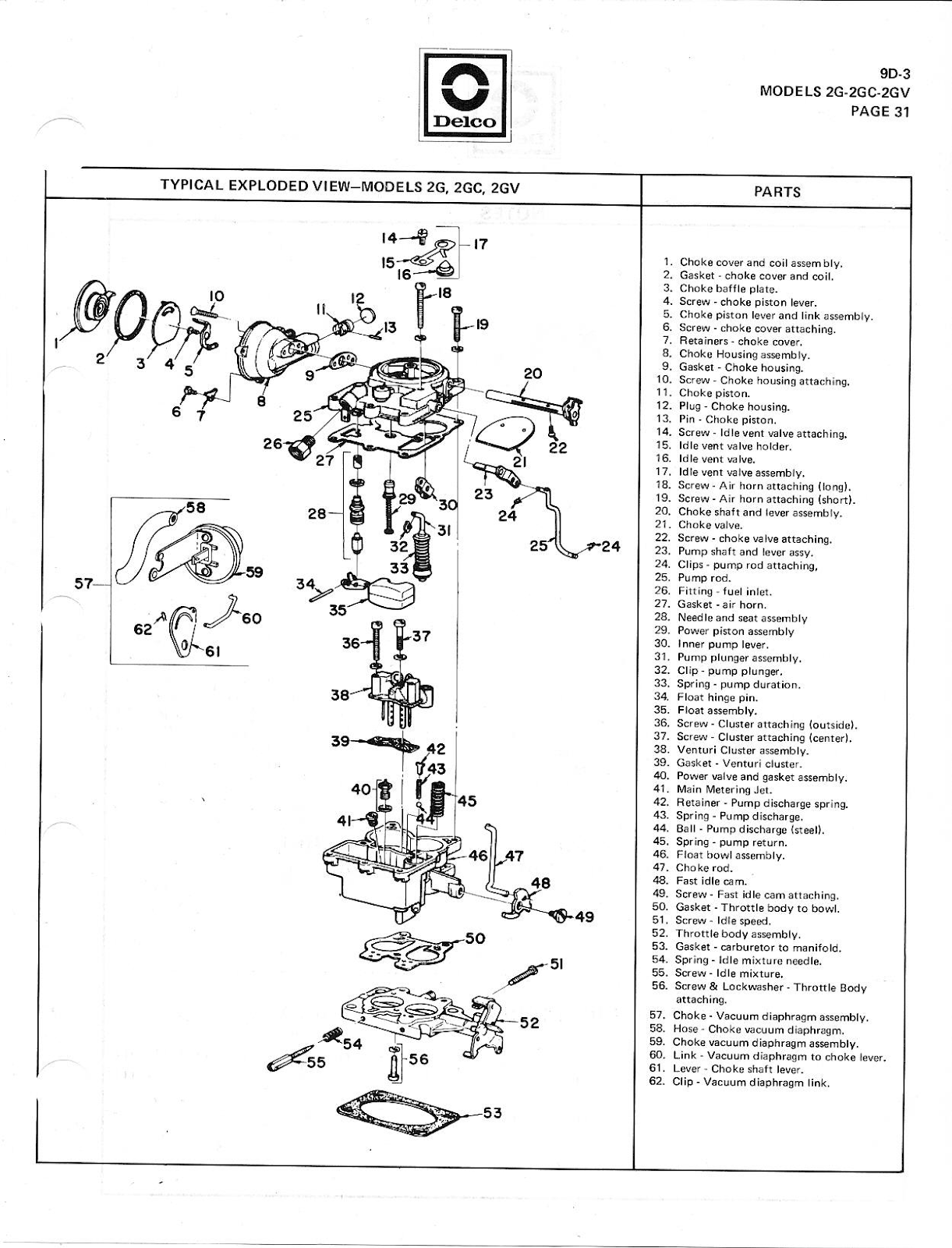


Rochester 2GC Two-Jet Exploded View

Rochester carburetors were primarily used as original equipment carburetors on Chevy and GM cars and trucks. Rochester carburetor applications spanned the range of engine sizes offered by GM. The carburetors had multiple designs ranging from the Rochester Mono-jet carburetor, to the dual jet Rochester carburetor, to the most popular Rochester quadra-jet carburetor.

Over time, the Rochester carburetors evolved from basis mechanical units to carburetors that were electronically controlled by the vehicles on board computer systems.

The main difference between Rochester carburetors used on the various GM product lines that include Chevy, Oldsmobile, Buick, Pontiac Cadillac and GMC is the throttle linkage configuration. For the most part, the linkage differs by product line. Rochester truck carburetors are usually different from car carburetors even if the engine size is the same. Rochester carburetors have numbers identifying numbers stamped into the body of the carburetor. They are either a eight digit number that starts with "17XXXXXX" or a seven digit number that starts with "7XXXXXX". Look for the number on the body of the carburetor. The carburetor may have similar numbers stamped on the base or top, the number on the body will more accurately identify the carburetor.

A common issue on Rochester re-manufactured carburetors is wear on the throttle shafts that leads to either fuel or air leaks. This issue can be overcome by inserting bushings to that the play out of the throttle shafts creating a tight seal. This process requires special tapered drills. Always make sure that the bushings are being replaced when you buy a re-manufactured Rochester carburetor.

Eight Cylinder Model Carburetor
Carer WCFA

The basic 265 had a two-barrel carburetor and was rated at 165 H.P. Horsepower was increased to 185 with the addition of a four-barrel carburetor, and an underrated 195 HP version, called the "Power Pack" had a high lift solid lifter cam, high compression heads, and dual exhaust.

The Carter WCFB
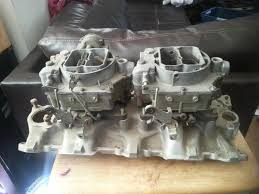
The Carter WCFB Power Pack Caburator Option

A Carter WCFA carburetor was available as optional equipment on 8-cylinder engines.  This carburetor was used when higher engine performance wa desired.

The Carter Model WCFB carburetor was basically two dual carburetors contained in one assembly.  The section containing the metering rods, accelerating pump and choke is termed the primary side of the carburetor, the other section the secondary side. It has five conventional circuits as have been used in non optional carburetors for the 1955 model year.  They are:

2-Float Circuits
1-Low Speed Circuit
2-High Speed Circuits
1-Pump Circuit
1- Control (choke) Circuit.

The purpose of the float circuits is to maintain an adequate supply of fuel a the proper level in the bowls for use by the low speed, high speed, pump and choke circuits.  Primary and secondary bowls are separated by a partition.  The fuel line connection is on the primary side.  Fuel is supplied to the primary and secondary intake needles and the seats through a passage in the bowl cover. Located at the fuel inlet.  

The WCFB was Carter’s first attempt at a four-barrel carburetor. It was introduced in 1952. A total of 222 different WCFB models were made in the years 1952 through 1967. The WCFB was discontinued after the 1967 model year. I have seen a number of different meanings for the WCFB acronym. One employee of Carter once told me that it meant “wrought cast four barrel”; and used that terminology for years. However, a close friend who worked most of his life for Carter, chastised me for using this terminology. It seems the official Carter meaning was Will Carter Four Barrel (Will Carter of course being the inventor that started the Carter Carburetor Company). So I now use this designation when asked.
The WCFB is a “square-bore” carburetor; with three major castings: (A) throttle body (early aluminum, later cast iron); (B) bowl (zinc alloy) and (C) airhorn (aluminum).

While some of the WCFB carburetors had no air valve, most of the WCFB carburetors have the weighted air valve to prevent the secondary from flowing until the engine demand was sufficient to require flow from the secondary. There were also a very few WCFB units that had vacuum controlled secondary. These units, like the vacuum controlled AFB carburetors, were (and still are) exceptionally troublesome. Carter discontinued this design after a couple of years.

The Carter WCFB Power Packt Exploded View
While there are many categories of parts on the WCFB that look as if they should interchange; two in particular that give many enthusiasts problems are metering rods and floats. The metering rod is an extremely precision device. Most enthusiasts look only at the metering diameters; but do not realize that the LENGTH of the metering step is not the same for all rods. Carter utilized at least a dozen different step length profiles. When interchanging rods, unless one is deliberately changing the step length, one should compare the step length profile of the replacement to the original rod. The floats used in the WCFB are a double pontoon arrangement, connected by an arm. THERE ARE SEVERAL DIFFERENT FLOATS, WHICH APPEAR TO THE NOVICE AS IDENTICAL! Maximum buoyancy of a float occurs when the flat surface of the float arm is perpendicular to the fuel inlet needle. A method used by Carter (also Rochester in their 4G series, and Stromberg in most of their two barrel series) to adjust the fuel level was to move the height of the arm where the arm was soldered to the pontoons. Failure to observe this difference in floats may lead to carburetor flooding issues. Even if the float arm is bent to achieve the specified adjustment, the buoyancy change may cause a flooding issue.

There were actually two WCFBs used in the 55 model year, the earlier style is called the "bell-crank" style because it has a large bell-crank connected to the throttle linkage. I understand that it was used up through early February with the round snout air cleaner, then the second more common style was substituted, along with the oval snout air cleaner. My 55 was assembled in mid-February and I used the second style and oval snout, though it originally had a two-barrel carb set-up.

Carter Carburetor Company in St. Louis, MO was established in 1909, and ceased operation in 1985. It was founded by William Carter, who started experimenting with automotive carburetors while running a successful bicycle shop. His first, cast brass carburetor could meter and deliver fuel more accurately than many competing units. He sold Carter Carburetor Company 13 years after founding it to American Car and Foundry Company, a firm older than Carter himself. Carl Breer wrote that, upon learning that the Ball family (owners of Ball & Ball) was planning to leave the carburetor business, he set them up with Carter, which continued to produce the Ball & Ball basic designs, which were used by Chrysler.

Carter adapted carburetors for Willys Jeep four-cylinder engines, waterproofing them for water crossings and making it possible to keep the engine going even on a steep incline (the Y-S carburetor). Carter also produced the first American four-barrel carburetor, used for Buick’s 1952 straight-eight, and followed by the WCFB on the 1955 Chrysler C300. This was eventually superseded by the AFB and the AVS. The final Chrysler use of four-barrel Carter carburetors was the Thermo-Quad, which used a lightweight theroplastic float bowl, on the most powerful Chrysler engines.

Carter produced Rochester Quadrajet carburetors for their rival maker whenever demand outpaced Rochester's ability to make them. They were identical to Rochester's units except the Carter name was stamped into the body. In Carter's final years in the early 1980s, they also produced Weber carburetors under license, such as the three-barrel Type 40IDA sold as replacements (or fuel injection retrofits) for 1960s and 70s Porsche 911 S.


!!!Support Texas Classic Experience!!!

Did you like the blog?  If you did, the best way to support Texas Classic Experience is to share this post!  Please tell others that you liked this post by sharing it with your car friends by sending them a link to this page.  http://texasclassicchevyexperience.blogspot.com/

Please use the add link to purchase auto part, books, etc

Don’t forget to visit and like Texas Classic Experience on FaceBook:  LINK to FaceBook
My winning Peel Out at the 2011 Lone Star Classic Convention in Dallas

Texas Classic Chevy Experience will post blogs about: Hot Rods, Chevy, Chevrolet, Drag Racing, Car Shows, Classic Cars, Custom Cars, Muscle Cars, How to Tech. posts, Dallas Area Classic Chevy Club, Texas Muscle Car Challenge, Tri-Five Nationals, Lone Star Chevy Convention, Classic Car lists, Classic car links, Spotters guides, Car Shows, Swap meets, Book reviews and More.


Sunday, April 24, 2016

1957 A Time Remembered and the 1957 Chevy Bel Air Fits Right In


1957 A Time Remembered
and the 1957 Chevy Bel Air Fits Right In
  -Alan Arnell


In 1957 the buying public enamored with continued growth of bigger taller tail fins on new cars, Automakers styled their cars with  more lights, bigger with more powerful engines.  The average car sold for $2,749. The Soviet Union launched the first space satellite Sputnik. Movies included "Twelve Angry Men" and "The Bridge Over the River Kwai", and TV showed "Perry Mason" and "Maverick" for the first time. The music continued to be Rock and Roll with artists like "Little Richard". The popular toys were Slinkys and Hula Hoops. Some of the areas that would cause problems later were starting to show South Vietnam is attacked by Viet Cong Guerrillas and Troops are sent to Arkansas to enforce anti segregation laws.


Sputnic and the Soviet Cold War Scare


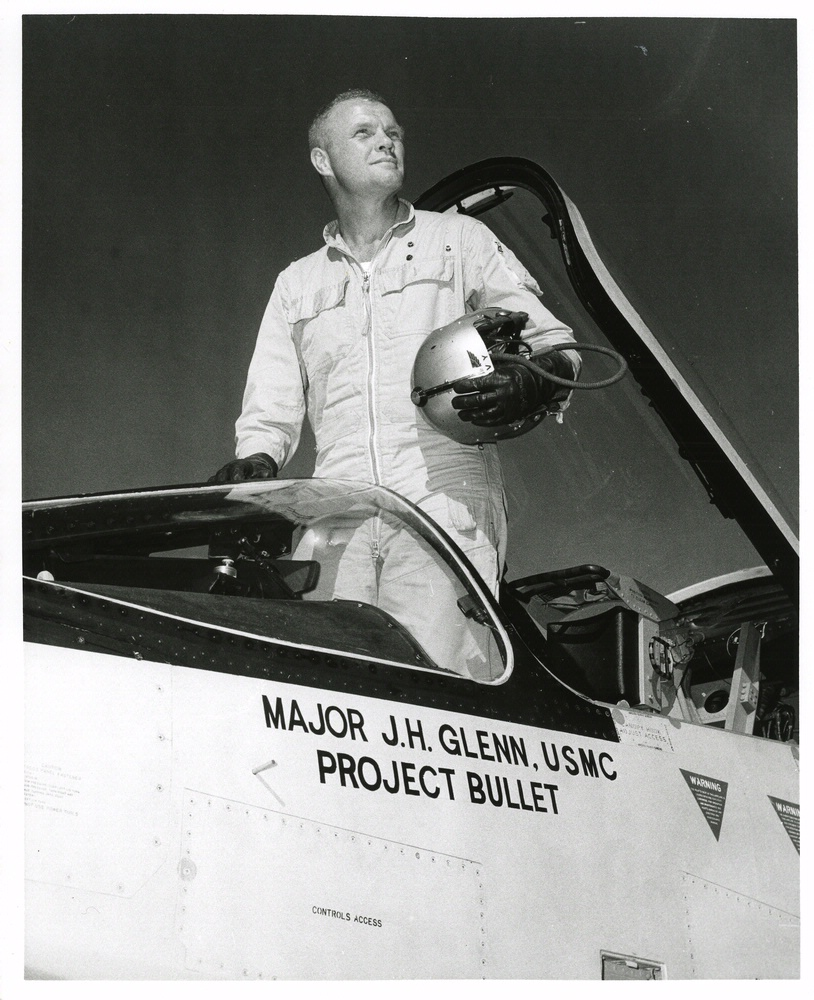
Technology was being embraced and celebrated.  For example, During July of 1957, test pilot and future astronaut, John Glenn Jr. set a new transcontinental speed record while piloting a F8U Crusader from Los Angeles to New York. He became the first pilot to average supersonic speed during a transcontinental flight and it took three hours and twenty-three minutes to complete. Glenn later became one of the first U.S. astronauts when he was chosen for the Mercury program by NASA in 1959. In addition to being an accomplished test pilot, he became the first American to orbit the Earth and the fifth person to go into space in 1962 aboard the Friendship 7 spacecraft.


John Glenn in his record breaking F8U Crusader


The cold war during during 1957 struck fear in the masses living in the USA, especially the school children learning to duck and cover in their classroom  The ever-present threat of nuclear annihilation had a great impact on American domestic life as well. People built bomb shelters in their backyards. They practiced attack drills in all public places. The 1950s and 1960s saw an epidemic of popular films that horrified moviegoers with depictions of nuclear devastation and mutant creatures. In these and other ways, the Cold War was a constant presence in Americans’ everyday lives.


Another family gem of our family traveling through Nevada.  It was a real nice hot day!


As a result, the stakes of the Cold War in 1957 were perilously high. The first H-bomb test, in the Eniwetok atoll in the Marshall Islands, was on people's minds showing just how fearsome the nuclear age could be. The blast created a 25-square-mile fireball that vaporized an island, blew a huge hole in the ocean floor and had the power to destroy half of Manhattan. Subsequent American and Soviet tests spewed poisonous radioactive waste into the atmosphere.


Enewetak, Atoll,  Marshall Islands


Meanwhile, back in the American heartland the populous prospered. Soldiers back from WWII and a 4 year college experience courtesy of Uncle Sam’s GI Bill were making up for lost time making a new spawn of American babies.  1957 was the peak of the Baby Boomer birth years.


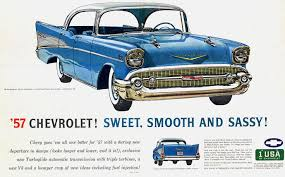
My favorite car maker Chevrolet was cruising along after the war’s stop in production of personal automobiles.  The car maker was turning out a line of cars that would eventually be recognized as one of America’s most popular designs.  More than 1.5 million Chevys were produced in 1957.  Actually, Ford made and sold more cars that Chevy in 1957, but the 1957 Ford did not produce the staying power of the general public's fancy as my beloved 1957 Chevy. Chevrolet had a great year in 1957 posting its third best production year for the largest division of General Motors.  


1957 Chevy Bel Air vs 1957 Ford Retractable


Those were the glory years for Chevrolet as the production numbers and their importance has long since faded.  What 50’s lovers remember or like to remember most about 1957 was the simplicity of life and the lack of immediate crisis.  To them, the 1957 embodies those times.


This favorable remembrance of the 1957 Chevy in part is fostered in part to many positive components like economy, styling and power.  The ‘57 Chevy was, some would say, the fuel for the fire of the Muscle Car era. The ‘57 sporty Bel Air symbolized strength to a country anxious about the Soviet Union’s actions in Europe.Fuel injection made it possible for engineers to increase the car’s horsepower, from a maximum of 225 in 1956 to 283 the following year.  Since gasoline was plentiful and cheap, selling around a 24 cents a gallon, few drivers cared about engine efficiency.  Cars not equipped with fuel injection had horsepower ranging from 162 to 270.


One of the most recognized icons in the automotive industry, the '57 Bel Air
Under the hood the V8s got an increase in displacement to 283ci with optional max power output to 283 hp with the Ramjet continuous flow fuel injection.


Ironically, the car’s muscle evolve from an engineering innovation that today is associated with gasoline savings-fuel injections, initially available on Corvettes, fuel injection eliminated the need for a carburetor by monitoring the amount of gasoline squirted into the cylinders.


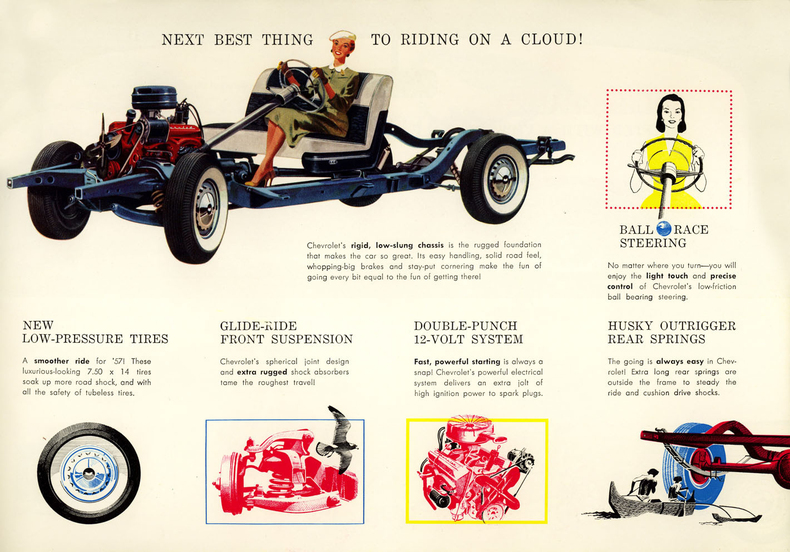
The car’s “Muscle” reputation was made larger by the car’s leaf spring rear suspension.  The 1957 was that last automobile to feature the suspension system that customizers and car racers loved.  They found it easier to raise and lower the leaf-spring suspension than it successor coil spring system.  


Muscle Car Timeline


Just as the true picture of the 1950’s had become blurred by time, so has one aspect of the 1957 Chevy’s reputation.  Some car guys have equated the muscle image with young men wearing black leather jackets, tight jeans rolled up shirtsleeves and waterfall haircuts.


In fact, there were many engineering innovation in the ‘57 Chevy, like an improved automatic transmission and a hill retarder that provided better braking during downhill runs.


Chevrolet”s appeal to the youth market was still a decade away and in 1957 adults were snapping up the cars.  Styling was one reason.  Elegance was a key work in the ‘50s and Chevrolet had its share.


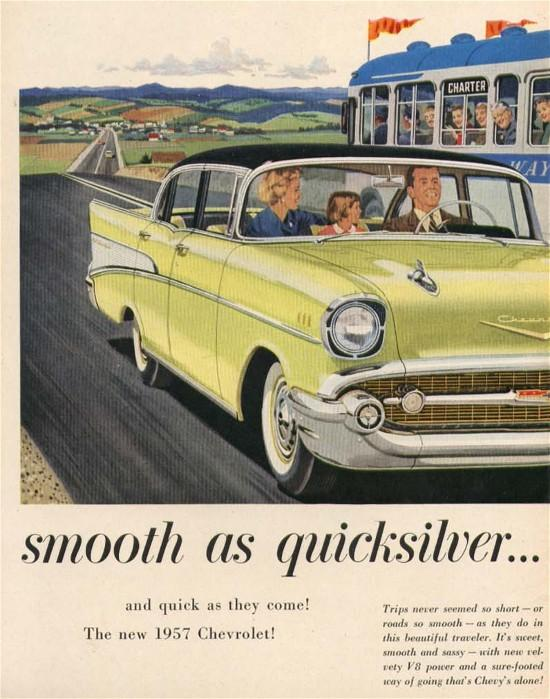
Smooth As Quicksilver and Quick As They Come!


Crafty designers built the car to look longer than it actually was.  They lowered the body one inch to emphasize the car’s horizontal sweeping lines.  The borrowed the prestigious look of the Cadillac Brougham, especially its hooded headlamps and tail fins.  The latter were as much in vogue in 1957 as horror movies, pizza and frozen foods.


The ‘50s were known more for looks and impressions than practicality, nevertheless the ‘57 Chevy was practical, too.  Because of it short wheelbase, the car handled well and got nearly 19 miles to the gallon.


For all its 1950’s styling featured on the ‘57 Chevy incorporated some engineering and design innovations that would be necessary in the safety and ecology conscious times to come.  There were fuel injection and good gas milage.  Exterior glass, so vital for better visibility, was upped six inches to 75 inches, and here was more interior room, especially head room


Bel Air Convertible Fuel Injection Convertible 1957


Chevrolet was much a part of its time as it was ahead of it.  Its combination of elegance and muscle, hard and soft, was a perfect metaphor for the contradictory 1950’s.  It is understandable why, into days times, people like to look back and dream about the way the thoughts things were.  And perhaps that also explains why the 1957 Chevy, almost any model, has not only kept it strength in the memory of Americans who owned them, but seems destined to be one of the great classics in automotive history.


1957 one of the great classics in automotive history during a iconic time in American History.


1957 Facts


Cost Of Living 1957-How Much things cost in 1957
Yearly Inflation Rate USA 3.34%, Yearly Inflation Rate UK 3.3%, Average Cost of new house $12,220.00, Average Monthly Rent $90.00, Average Yearly Wages $4.550.00, Cost of a gallon of Gas 24 cents, Bacon per pound 60 cents, Eggs per dozen were 28 cents, HI FI Portable Record Player was $79.95, Children's Shoes $5.95


Popular Culture


Elvis Presley purchases a mansion in Memphis, Tennessee and calls it Graceland
The Cavern Club opens in Liverpool ( Where the Beetle's started )
The Film Jailhouse Rock premiers with Elvis Presley
"American Bandstand" the teenagers chart music show makes its network debut on ABC


Popular Films


The Ten Commandments
Around the World in Eighty Days
12 Angry men
Jailhouse Rock by Elvis Presley
The Bridge on the River Kwai
The Three Faces of Eve


Popular Books
The Cat in the Hat - Dr. Seuss
From Russia with Love - Ian Fleming
The Guns of Navarone - Alistair MacLean

Tuesday, February 9, 2016

Classic 1955, 1956, 1957 Chevrolet Nomad History


Classic 1955, 1956, 1957

Chevrolet Nomad History

  -Alan Arnell


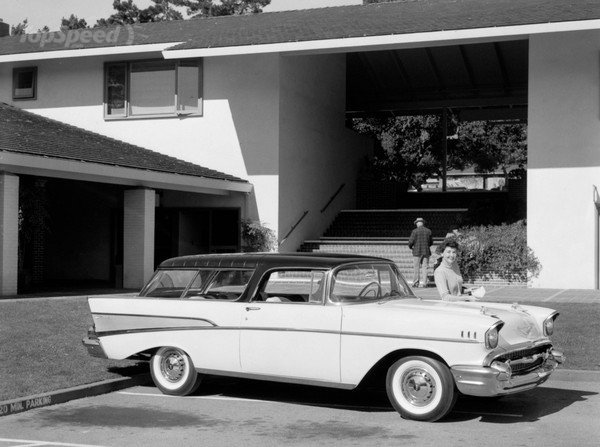
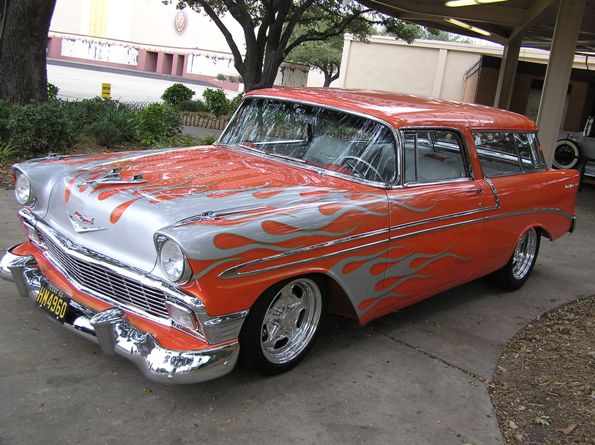
One of the best beloved Tri Five Chevys ever is the Chevy Nomad.  The Nomad was a station wagon model that was sold on and off from 1955 until 1972.  Sadly, in the late 1970’s and early 1980’s the Nomad was a Chevy Van trim package.  We will ignore that error in judgement.


In the world of wanting, selling and buying Tri Fives Chevys the Bel Air 2-door hard tops are at the top of the pyramid.  However a Nomad is a close second in the like time line.  I will not go out on a limb when I say that the prettiest wagon ever made was the Nomad.  

LINK TO GET ACCESS TO A FREE FULL LENGTH HOT ROD NOVEL, If you like books about cars check it out.   


General Motors in the mid 1950’s had Harley Earl.  He was a great design manager and was a huge part of making the Tri Fives such classics.  In the design of the Nomad, Clare MacKichan and Carl Renner were the main people in the actual design of the Nomad.  As almost a lark the Nomad duo made a sketch of a two door Sport Wagon.


At that time the Corvette design was a big hit. They drew up a Corvette as a wagon.  With Harley Earl on board a station wagon version of a Corvette concept car was made for the 1954 Motorama.  


Useless fact: How did the station wagon get its name.  When trains came into the station luggage was carried on wagons.  After the introduction of automobiles into the movement luggage a special car was developed for that purpose.  You did not want to ride in a truck to a classy hotel now would you?  Since you rode in these cars from the railroad station to your final destination, the cars were coined as Station Wagons.  Watch the movie “White Christmas.” When the 4 main characters are picked up at the train station in Pine Tree, Vermont they were picked up in a 1950 Plymouth Special Deluxe Woody Station Wagon.


The youth market was big in the mid 50’s.  So all Chevys in 1955 in one way or another was made sporty for the youth market. Thus called the “Hot One.” So, a sports station was not really out of left field.  The Corvette wagon was such a big hit the marketers and designers took the concept to a more workable product.  


Harley Earl recognized that the Corvette wagon’s roof line would look great on lower body lines of a 1955 Chevy. Things were able to move fast in those days.  Harley Earl told MacKichan to adapt its roofline to the ‘55 passenger car and that he needed it done in two days!  The Corvette wagon’s top being made of fireglass was cut off stretched out and put on a 55’s lower body.  


MacKichan later wrote, “1955 Chevrolet lower body,... the hardtop front-door glass framing, forward-sloping rear quarters, wide B- pillar, fluted roof, wraparound rear side glass, the rear wheel housing cutout, and the seven vertical accent strips on the tailgate were all retained in a remarkable good translation from the dream car.”


One major difference done in the production run vs. the concept car was the use of a conventional liftgate instead of the concepts car’s drop down tailgate window.  And, according to my friends in the Dallas Area Classic Chevy Club all Nomad’s rear windows leak.  There is nothing you can do about that sad fact.


The Nomad had a relatively short wheelbase and overall length like as the coupes, sedans and station wagons of the same time frame.  


At first glance the Nomad looked like all the other wagons in the Chevrolet product line.  However the ‘55 Nomad after the cowl was in reality the most expensive Chevy to produce.  A whopping $265 more than the hot similarly equipped Bel Air Convertible in 1955.  


All in all, the lack of four doors kept traditional wagon buyers away from buying the Nomad.   Besides water leakage there were also complaints that the vast rear slanted window could make for a hot car.  Exhaust fumes had a tendency to leak through the rear tailgate especially with the window open.  The Nomad was the least popular Chevy in 1955.


Despite less than expected sales Chevrolet stuck with the concept and made a 1956 model.  However, some price cutting was done to the Nomad.  Changes for the ‘56 was to not have a unique seat pattern, but to incorporated the standard Bel Air hardtop pattern.  The ‘56 V-model did have a small chrome “V” below each tail lamp vs. the non nomad that only a large “V” on the trunk lid or tail gate.


The rear-quarter “slash” molding was made to match the B-pillar’s  unique angle in 1956.  


Even with the changes, the Nomad still costed $138 more, thus sales were not stellar. Not making its sales goal of 10,000 units in 1955 and 56 prompted Chevrolet to suspend sales in 1958.


Yet, Nomad lovers were blessed with a 1957 nomad.  The ‘57 model year retained the good parts of its predecessors and passenger models. Yet, designers could not get the price down as the ‘57 Nomad was $150 more in 1957.  The Nomad in ‘57 saw its lowest production of units of the Tri Five era.  Trim on the Nomad was basically stock Bel Air.  The only difference was the Nomad script and small gold “V” on the V-8’s tail gates.   


Subscribe to Texas Classic Chevy Experience


The Nomad’s specification for 1955 were either a 6-cylinder 235.5 cid at 123/136 bhp or a V-8 cylinder engine with 265 cid at 180 bhp with a power pack option.  Transmissions offered were either a 3-speed manual; overdrive, 2-speed power-glide.  The wheelbase was 115 inches.  Top speed was stated as 120 but really 90 mph.  A turbo-glide and a 283 V-eight engine was offered.


So you ask, why is the Chevy Nomad so popular and valuable?  It had a small production run compared to other Tri Five Chevys,  that could make it worth more, the old supply and demand thing, but the real reason is for the same reasons in

“Ode to the Fins” LINK.  The real reason is because people love the Classic Nomad Tri Five Nomad.


From Ode to the Fins: “What makes the Tri-Five Chevy the car which set the pace for all other older cars? Why has this car received so much attention and recognition, even more than the 1957 Ford, which out sold the '57 Chevy? Well if you don't know by now, you may never know. Everyone knows that the '57 Chevy is the greatest general use passenger car (This man's opinion) of all time is because of its styling, engineering, performance and the millions of people like you and me that love the fabulous 1957 Classic Chevy.”


++++


#Classicchevy #TriFive #ClassicCar #Chevy #Chevrolet #Belair #Carshow #Custom #Musclecar   #HotRod #StreetRod #DragRacing #55Chevy #56Chevy #57Chevy


!!!Support Texas Classic Experience!!!
Did you like the blog?  If you did, the best way to support Texas Classic Experience is to share this post!  Please tell others that you liked this post by sharing it with your car friends by sending them a link to this page.  http://texasclassicchevyexperience.blogspot.com/


Don’t forget to visit and like Texas Classic Experience on FaceBook:  LINK to FaceBook
Texas Classic Chevy Experience will post blogs about: Hot Rods, Chevy, Chevrolet, Drag Racing, Car Shows, Classic Cars, Custom Cars, Muscle Cars, How to Tech. posts, Dallas Area Classic Chevy Club, Texas Muscle Car Challenge, Tri-Five Nationals, Lone Star Chevy Convention, Classic Car lists, Classic car links, Spotters guides, Car Shows, Swap meets, Book reviews and More.